Introduction
The leisure industry is a life-oriented industry, and there is an urgent demand for both the quality and quantity of personnel engaged in it.
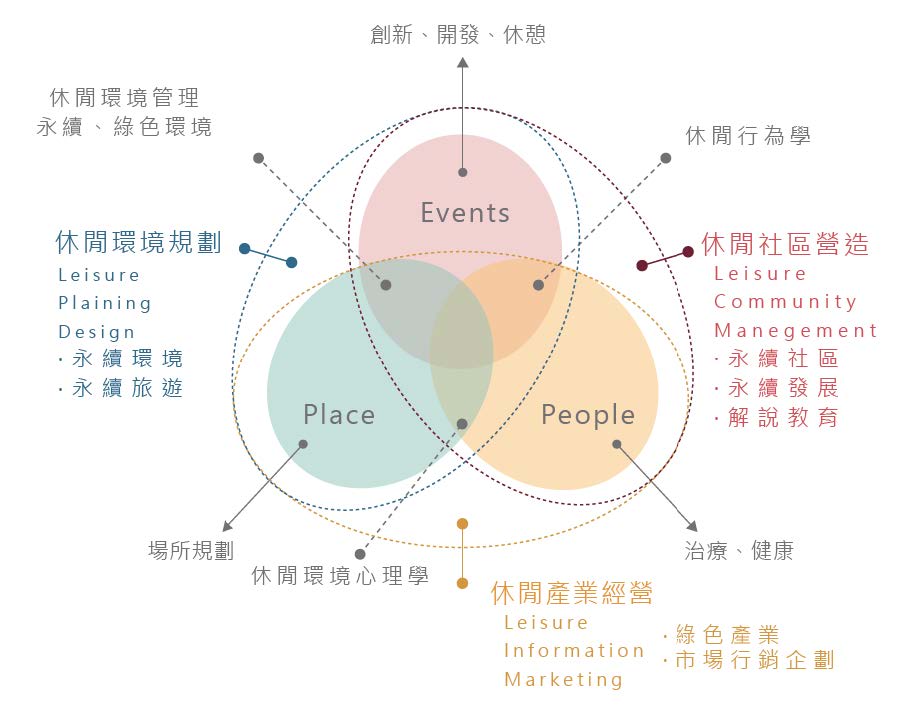
Therefore, the primary objective of establishing this department is to correspond with the development trends of the leisure industry, focusing on community development, leisure environment planning, and leisure activity services as its main axes. The fundamental educational mission is to cultivate outstanding professionals for the leisure industry in planning, development, maintenance, and management.
Based on the objectives of establishing the department, it has continuously strengthened its faculty and facilities, while also responding to the needs of the social environment and continuously reviewing and improving its programs. By integrating the development direction of community development, it aims to combine theoretical foundations with practical operations in order to cultivate professionals in leisure and recreation management and community development who possess both international perspectives and local characteristics.
During the course of economic development in the Taiwan region, improvements in living standards have led people to place increasing importance on quality of life. Government agencies have also proposed establishing a “Technology Island Life” as the overall national development direction for the future. In addition, with the awakening of environmental protection awareness, the pursuit of high-quality leisure lifestyles that also incorporate ecological and environmental protection has gradually become an essential element for people seeking an ideal living environment. This has directly contributed to the vigorous development of the leisure, recreation, and tourism industries in the Taiwan region.
Good design, development, and maintenance of leisure spaces can enhance people’s experience of high-level spatial aesthetics and transform it into high-quality leisure experiences. Through proper design, development, and maintenance of the limited land resources available for leisure industries, the most effective allocation and utilization of leisure resources can be achieved. This not only allows people to enjoy a good leisure life, but also improves the physical living environment.
This department has consistently trained students in planning and design abilities, and hopes to promote community development and activity planning, cultivating leisure and recreation professionals who possess environmental ecology awareness, humanistic aesthetics, creative thinking, and practical skills to participate in the leisure industry. Through its curriculum, the department also guides students to focus on the industrial characteristics of Yunlin, promoting the transformation of the leisure environment in the Yunlin region. By integrating the existing practical experience of leisure and recreation in Yunlin, it serves as the practical foundation for course design.
Objectives and Professional Development Directions
As the domestic leisure, recreation, and tourism industries gradually approach saturation, the demand for service and management personnel in leisure and recreation is also reaching a saturated level. However, within Taiwan’s leisure and recreation industry, there remains a significant deficiency in “spatial quality” and “environmental aesthetics.” Especially with the increasing frequency of international tourism, foreign visitors often hold higher standards for the environmental aesthetics of Taiwan’s tourist attractions. At the same time, local citizens who have traveled abroad also develop higher expectations regarding the spatial quality of domestic leisure and recreation environments. Furthermore, communities and the leisure industry are closely interconnected. Communities contain local culture and characteristic industries. Through the spirit and strength of comprehensive community development, not only can the spatial quality of community living environments be improved and residents’ sense of community cohesion strengthened, but local cultural creativity and characteristic industries can also be further promoted, such as ecological community tourism, rural regeneration, and the revitalization of historic streets.
National Formosa University is a technological university within the technical and vocational education system. It places special emphasis on the development of students’ hands-on practical abilities while maintaining close collaboration with industry. This includes arranging curricula that align with industry directions and ensuring that students’ practical project topics meet the needs of industry, so that after graduation they can immediately apply their expertise and enter the workforce.